
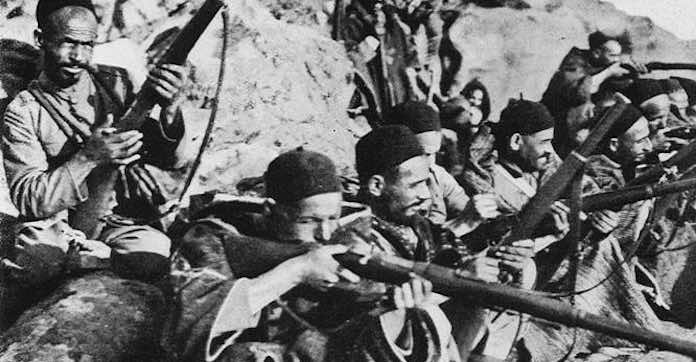
In the rugged Rif Mountains, a defiant cry for freedom echoed, forging a spirit of resistance that would inspire a continent and define a people for generations.
Introduction
The Rif War (1920-1926) was more than a colonial conflict; it was a watershed moment that forged a lasting symbol of resistance and reshaped the cultural and political landscape of North Africa. For five years, the Riffian fighters, led by the visionary Abdelkrim Al-Khattabi, waged a stunningly effective war against two European powers, Spain and France, achieving what was considered impossible at the time. Their struggle, though ultimately defeated on the battlefield, left an indelible mark on the soul of the region. This article explores the pivotal events of this war, the profound sense of Riffian pride it ignited, and its enduring legacy—a legacy that continues to inspire cultural expression and identity, including the very philosophy behind modern streetwear brands like Rifwear.
The Rif War: A Pivotal Struggle for North Africa
Fought from 1921 to 1926, the Rif War was an armed conflict between the Berber tribes of the mountainous Rif region of northern Morocco and the colonial powers of Spain and later France . The war erupted from longstanding resistance to European encroachment, which had been formalized by the 1912 Treaty of Fez that established a French protectorate over most of Morocco and a Spanish protectorate in the north . The Rifian people, who had maintained de facto control over their lands for centuries, fiercely opposed this foreign domination, particularly as Spanish expansion threatened their territory and resources .
The conflict is best remembered for the brilliant leadership of Muhammad ibn Abd al-Karim al-Khattabi, known as Abd el-Krim. A former Islamic judge, journalist, and teacher, Abd el-Krim initially believed Spain would modernize the protectorate but turned to resistance when he realized the true nature of colonization . He united the disparate Rif tribes into a formidable force, employing innovative guerrilla tactics that capitalized on their knowledge of the treacherous mountain terrain .
The war’s most spectacular moment came in July 1921 at the Battle of Annual, where Abd el-Krim’s forces decimated the Spanish army, inflicting a catastrophic defeat that resulted in an estimated 10,000-16,000 Spanish casualties . This victory was not just a military success; it was a declaration of sovereignty. Buoyed by this triumph, Abd el-Krim proclaimed the Republic of the Rif in September 1921, a bold experiment in independent statehood with its own administration and a vision of modernity influenced by Islamic reformist and Kemalist ideas .
Table: Key Figures of the Rif War
| Figure | Role | Significance |
|---|---|---|
| Abd el-Krim | Military and political leader of the Rif Republic | Unified Rif tribes, masterminded guerrilla strategy, and founded a proto-state . |
| Manuel Silvestre | Spanish General | Commanded the Spanish forces that were defeated at the Battle of Annual . |
| Philippe Pétain | French General | Took over French command and led the joint Franco-Spanish offensive that ended the war . |
| Hubert Lyautey | French Resident-General | Initially opposed joint action with Spain; was replaced by Pétain . |
The success of the Rif Republic, however, could not be sustained indefinitely. Alarmed by Abd el-Krim’s incursions into the French protectorate in 1925, France and Spain set aside their rivalries to form a powerful military alliance . In a massive joint operation, including a major amphibious landing at Al Hoceima, the colonial powers overwhelmed the Rifian forces . Facing certain defeat and the use of devastating new weapons like chemical gas, Abd el-Krim surrendered to the French in May 1926, bringing the war to a close, though Spanish Morocco was not declared fully pacified until 1927 .
The Birth of Riffian Pride: Forging a Legacy of Resistance
The Rif War was a crucible in which a distinct and powerful Riffian identity was forged. For the first time, disparate tribes united under a single banner, transcending parochial loyalties to fight for a common cause. This unity in the face of overwhelming odds became a foundational narrative of Riffian pride and resilience. The conflict demonstrated that a disciplined and motivated force, deeply connected to its homeland, could challenge and humiliate modern European armies . This knowledge—that their ancestors had fought for and nearly achieved self-determination—became a core pillar of the Riffian psyche.
Central to this emerging identity was the figure of Abdelkrim Al-Khattabi. He was not merely a military commander but a state-builder and a symbol of intelligent, principled resistance. As one historical account notes, he was seen as “a reminder of more chivalrous times, when man-to-man combat and personal honor took precedence,” a stark contrast to the anonymous slaughter of World War I . His ability to centralize an administration, collect taxes, and attempt to build modern institutions showed the Riffians were capable of more than just warfare; they were capable of self-governance . His surrender in 1926 did not tarnish his legacy but rather cemented his status as a folk hero and a timeless icon of the fight for freedom.
The immense human cost of the war also seared this period into collective memory. While Spanish casualties were estimated at over 43,000 and French at around 18,000, the Riffians suffered an estimated 30,000 casualties, with many being civilians who fell victim to privation, retaliation, and aerial assaults, including the use of poison gas . This suffering was not forgotten; it became a historical wound that reinforced a sense of distinctness and a right to dignity. The war established a “legacy of resistance” that would inform Riffian relations with central power for decades to come, creating a local identity that often stood in contrast to state-promoted narratives .
Legacy of Resistance: From Historical Conflict to Modern Identity
The spirit of the Rif War did not vanish with Abd el-Krim’s exile. Instead, it became a potent symbol of resistance that has continued to resonate throughout the 20th and 21st centuries, influencing both the North African identity and ongoing struggles for recognition and rights.
A Beacon for Anti-Colonial Movements
The Rif War served as a direct inspiration for liberation movements across Africa and the Arab world. The tactics and success of Abd el-Krim were studied by revolutionaries, with some historians considering the Riffian insurgency a precursor to later wars of decolonization, such as the Algerian War . The conflict demonstrated that European colonial powers could be successfully challenged, fueling the fire of anti-colonial sentiment that would sweep the continent in the following decades.
The Rif in Modern Morocco
Within Morocco, the Rif region has maintained a distinct identity, often defined by its “historically conflictive relationship with the central power” . The memory of the Rif Republic and the subsequent heavy repression under the Franco-Spanish Protectorate and the post-independence Moroccan state has played a crucial role in shaping a resilient local identity. This historical memory is not confined to textbooks; it is embedded in the very landscape. For the Rifian people, historical heritage includes abandoned government buildings from the Rif Republic, trenches from the war, and sites linked to its leaders—all serving as tangible reminders of their history of resistance .
This legacy of defiance came to the fore once again in recent times with the Hirak protest movement that began in Al Hoceima in 2016. A massive social movement with transnational reach, Hirak was catalyzed by the death of a fish vendor and grew into a widespread demand for economic dignity, cultural recognition, and an end to marginalization . The protests saw demonstrators waving the flag of the historic Rif Republic, a clear and powerful evocation of the region’s long-standing struggle for justice and self-determination . This demonstrates how the Rif War remains a living history, providing a framework and a language for contemporary social and political engagement.
How the Rif War Inspires Modern Streetwear
At Rifwear, we look to the profound history of the Rif not merely as a lesson in the past, but as a living source of inspiration. The same values of resilience, identity, and cultural pride that defined the Riffian resistance a century ago are the very principles that inform our designs and our brand philosophy. We believe that clothing is more than fabric; it is a canvas for storytelling and a modern vessel for carrying forward a powerful legacy.
Weaving History into Fabric
The Riffian culture is rich with visual identity, from the earthy tones of the rugged Rif mountains to the traditional aesthetics of Berber craftsmanship . Our designs draw from this palette, using earthy tones juxtaposed with vibrant accents that symbolize both the land and the passionate determination of its people . We integrate elements that echo the strength and dignity of Riffian heritage, creating pieces that are deeply meaningful and visually striking.
A Philosophy of Defiance and Dignity
Our brand is built on the same pillars that supported the Riffian resistance:
-
Strength in Unity: Just as Abdelkrim Al-Khattabi united diverse tribes under a common cause, Rifwear strives to build a community brought together by shared values and a bold vision. Our clothing is meant to be a symbol of that unity.
-
Resilience in the Face of Adversity: The incredible tenacity of the Riffian fighters, who took on two empires with limited means, inspires us to create with quality and durability at our core. It’s the spirit of overcoming the impossible.
-
Pride in Identity: The Rif War was ultimately a fight for the right to self-determination and cultural preservation. In a modern world, wearing Rifwear is an act of celebrating that identity, an unapologetic declaration of pride in a rich heritage.
Much like another brand that draws from this history, creating a “wearable history lesson,” we at Rifwear aim to make the powerful story of the Rif accessible and relevant for a new generation . Each piece is an invitation to reflect on themes of resistance, identity, and the enduring spirit of a people who shaped history.